
Hancock County Arrest to Court Records
After an arrest in Hancock County, the jail and the court handle different parts of the same event. The Hancock County Sheriff's Office handles custody, booking, jail rules, release payment instructions, mail, property, and visitation at Hancock County Jail. The court record starts with the formal case path through Hancock County Circuit Court in the 9th Judicial Circuit. That path can include an early appearance or pretrial hearing, prosecutor review, a charging document, docket entries, court orders, and a final disposition.
The court file should not be read as the same thing as a booking record. Booking details and custody questions belong with Hancock County jail inmate records, while booking photos belong with Hancock County jail mugshots if a public photo request is the goal. Court records after a jail arrest focus on what charges were filed, whether they changed, whether a warrant or pretrial order appears, and how the case ended. A booking charge can be amended, reduced, dismissed, or replaced by a formal charge after review.
The local scale is rural and court-centered. Hancock County cases are handled from the courthouse square in Carthage, while jail custody is handled nearby at the Buchanan Street sheriff facility. The court process is active but not built like a large urban jail portal with a single public dashboard. Phone, clerk contact, Judici access where available, court copies, and written records requests all matter.
Hancock County Circuit Clerk Records
The official court record route is the Hancock County Circuit Clerk. The office is led by Circuit Clerk Keara Weber and can be reached at 217-357-2616 or kweber@9thjudicial.org. The courthouse is listed by Illinois Courts at 500 Main Street, Carthage, IL 62321, with public hours of 8:00 a.m. to 4:00 p.m. The Circuit Clerk page also references copy requests, fines and court costs, court scheduling, e-filing help, Zoom links, jury questionnaire resources, and Lawyer in the Library information.
The Illinois Courts directory page for Hancock County Courthouse identifies the court as District 4, Circuit 9. It also lists accessibility resources, free parking around the courthouse square, and the Circuit Clerk as the disability coordinator contact. Those courthouse details matter because a person looking for court records after a jail arrest may need a certified copy, a payment record, a court date, or a docket question that a jail officer cannot answer.
The Circuit Clerk page is a subject match for Hancock County court records after arrest and shows the local office that maintains court copy and scheduling routes.
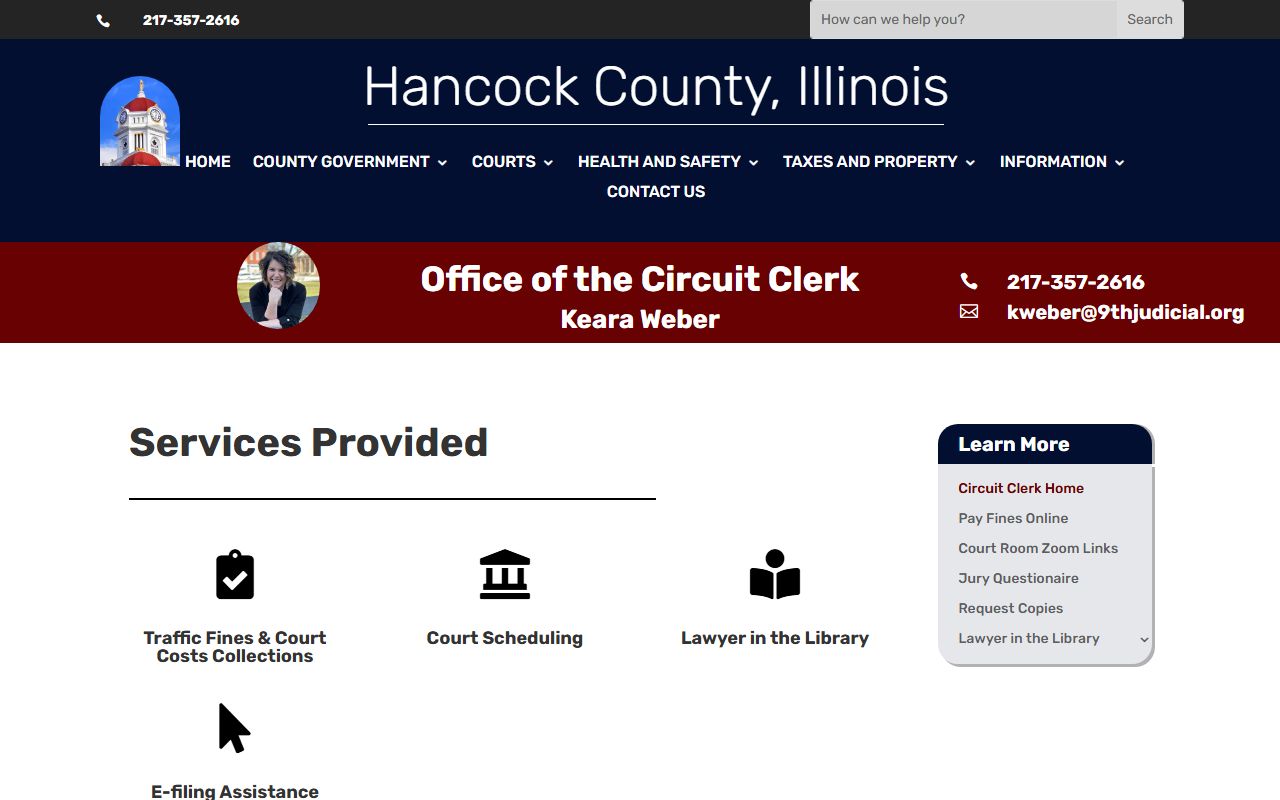
Use that office for official copies and court-record questions, then use the jail only for custody and booking questions tied to the same arrest.
Find Hancock County Court Records After Arrest
Judici is a likely search path, but it should be used with care. The Judici Illinois courts listing shows Hancock County Circuit Court through the 9th Judicial Circuit, and the Judici participating courts page lists Hancock County in court search and plea-pay dropdowns. The direct Hancock County case-search page triggered a humanity check during research, so exact fields on that direct case page should not be overstated. Certified copies and official file questions still route to the Circuit Clerk.
The 9th Judicial Circuit provides regional court context for Hancock County, Fulton, Henderson, Knox, McDonough, and Warren Counties. Its court resources can help with Zoom links, local court information, judge listings, and circuit-level context. Court records after a Hancock County jail arrest still remain local to the case and the Circuit Clerk unless the case moves through an appeal or another court level.
| Access Route | What It Helps With | Limits |
|---|---|---|
| Circuit Clerk | Official copies, docket questions, fines, court costs, scheduling, and case file routing. | No public search fields were visible on the office page itself. |
| Judici | Participating-court lookup and plea-pay court selection where Hancock County appears. | Direct case search may require interactive access and is vendor-operated. |
| 9th Judicial Circuit | Circuit context, court links, remote court resources, and judge information. | Not a jail roster or booking-photo source. |
| Illinois Courts | Courthouse directory, public hours, accessibility, and statewide court resources. | Directory pages do not replace the local court file. |
Hancock County Arrest Court Path
The basic path is arrest, booking, first appearance or pretrial hearing, prosecutor review, filed charge, docket activity, disposition, and sentence or release. Hancock County Jail is the booking point for local county custody. The Circuit Court and 9th Judicial Circuit handle the court stage. The State's Attorney reviews the case and decides how to proceed with formal charges. The Circuit Clerk then maintains the public court record, subject to law, sealing, expungement, and access limits.
- Confirm the custody event through the jail if current detention is the first concern.
- Check the Circuit Clerk or Judici route for a filed court case after the arrest.
- Read the charge list as formal allegations, not as proof of guilt.
- Track docket entries for amendments, hearings, warrants, release conditions, plea, trial, dismissal, or sentence.
- Request official copies from the Circuit Clerk when a certified or complete record is needed.
Illinois pretrial law also affects the wording. Hancock County's jail page may still use legacy operational terms such as bail for release payment instructions, but current Illinois pretrial decisions are made by the court. A judge decides release with conditions or detention after the legal criteria are addressed. A person may also remain held if another agency hold, state custody issue, federal authority, immigration matter, or court detention order applies.
Hancock County Charging Decisions
The Hancock County State's Attorney is the prosecutor for local criminal cases. Bobi Gail James is listed as State's Attorney, with phone 217-357-3916 and email james@hancockcounty-il.gov. The office prosecutes felony, misdemeanor, traffic, and juvenile matters, provides victim-witness services, and gives legal guidance to county officials. The page reports about 200 felony cases, 150 misdemeanor cases, and 2,000 traffic cases each year.
The prosecutor's office is not the jail and is not the public defender. It decides what charges to file or maintain after review, but it does not provide private legal advice for defendants, family members, or civil disputes. The official page says the office cannot represent private citizens in divorce, custody, landlord-tenant, bankruptcy, debt collection, adoption, vehicle crash, or breach-of-contract matters. Victims should use the office's victim-witness route when applicable, while defendants should use counsel or court resources for legal advice.
| Document | Usually Filed By | What It Means |
|---|---|---|
| Complaint | Law enforcement or prosecutor | Starts or supports a criminal case with sworn allegations after an arrest or investigation. |
| Information | Prosecutor | Formal charging document used by the State's Attorney for many prosecuted cases. |
| Indictment | Grand jury process | Formal charge returned through grand jury review, often tied to more serious felony handling. |
Hancock County Charge Status Records
Charge status is the part of the court record that often changes most. A jail booking may begin with a holding reason, but the filed case can show different or more precise counts after prosecutor review. Court records after arrest may show pending charges, amended counts, reduced offenses, dismissed counts, a plea, a trial result, probation, jail time, prison sentence, fines, costs, or release conditions. Each count should be reviewed by itself because one case may contain several charges with different outcomes.
| Status | Plain Meaning | Reader Caution |
|---|---|---|
| Pending | The charge is still active and no final result is shown. | Do not call it a conviction. |
| Amended | The charge text, class, statute, or count may have changed. | Compare the latest docket entry, not just the first filing. |
| Reduced | The prosecuted charge may be lower than the original allegation. | Check whether other counts remain active. |
| Dismissed | The court record shows the count or case was dismissed. | A dismissal does not always erase every public record by itself. |
| Convicted | A plea or verdict resulted in guilt on that count. | Read sentence, fines, probation, jail, or prison terms separately. |
| Warrant | A court order may authorize arrest or require action. | Verify status with the court, sheriff, or counsel before acting. |
For a sentenced state-prison transfer, the court record may later connect to the IDOC Individual in Custody Search. IDOC is not for a fresh Hancock County jail booking. It is for sentenced state custody after commitment and transfer.
Hancock County Warrant Records
No current official Hancock County online active-warrant search was located in the reviewed sources. Older official warrant PDFs from 2020 and 2021 exist in county or sheriff uploads, but those lists are stale and should not be treated as current warrant data. Old names should not be republished. The useful lesson from those PDFs is only the field pattern: document or warrant number, issue date, name, sex, race, date of birth, address or location, and reason such as failure to appear or failure to pay.
Current warrant questions should be verified through the Hancock County Sheriff's Office at 217-357-2115, the Circuit Clerk at 217-357-2616, court counsel, or an appropriate court appearance. An arrest warrant can lead to booking at Hancock County Jail. A bench warrant may issue after failure to appear or failure to comply. A warrant from another jurisdiction may turn Hancock County into a temporary holding location, which means local release may not resolve the full custody issue.
Important: Do not rely on old warrant PDFs or unofficial databases to decide whether a Hancock County warrant is active.
Charges and Convictions Compared
A charge is an accusation in a court case. A conviction is a final legal outcome after a guilty plea, verdict, or other qualifying disposition. Hancock County court records after arrest may show both, but they are not the same. A person can be arrested, charged, and later have the charge dismissed, reduced, amended, or resolved without a conviction on the original count.
| Point | Charge | Conviction |
|---|---|---|
| Stage | Filed allegation after arrest or review. | Final result on a count through plea, verdict, or qualifying finding. |
| Proof | Not proof that the person committed the offense. | Shows legal guilt for that count unless later changed by court action. |
| Record Use | Useful for tracking the open court case. | Useful for sentence, probation, fine, custody, and criminal-history questions. |
| Possible Changes | Can be amended, reduced, added, or dismissed. | May be appealed, vacated, sealed, or expunged only through proper legal process. |
Sealed and Expunged Court Records
Illinois law provides sealing and expungement routes under 20 ILCS 2630/5.2. Eligibility depends on the charge, outcome, waiting period, prior record, and court order. A dismissal does not automatically remove every jail, arrest, mugshot, or court reference from public view. The official route is a court process, and agencies must follow valid orders once entered.
| Point | Sealed | Expunged |
|---|---|---|
| Public View | Hidden from most public access. | Removed or treated as not having occurred for many official purposes. |
| Agency Access | Some law-enforcement or authorized access may remain. | Access is more limited, but not every trace outside official systems disappears. |
| Best For | Eligible records that cannot be fully erased but can be shielded. | Eligible arrests or outcomes that qualify for stronger relief. |
| How It Happens | By petition and court order. | By petition and court order. |
Public Access Limits
Illinois FOIA defines public records and gives a written-request process, but it also has exemptions. 5 ILCS 140/2 defines public records broadly. 5 ILCS 140/3 sets the basic inspection and response framework. 5 ILCS 140/7 covers exemptions and redaction rules. These laws help explain why one record may be available, another may be redacted, and a sealed or juvenile matter may not appear in a public search.
Arrest information has its own Illinois FOIA provision. 5 ILCS 140/2.15 requires law-enforcement agencies to make specified arrest information available, including a photograph when and if available, but that does not turn every court record into a mugshot gallery or every booking note into a public web page. Court copies, jail records, prosecutor files, and law-enforcement records each have separate custodians and limits.
For consumer screening, use a legally compliant source. Public-record summaries are not consumer reports under the Fair Credit Reporting Act and are not for credit, employment, insurance, housing, tenant screening, or any other FCRA-covered use.
Victim and Custody Notifications
Illinois VINELink is useful when custody or case status notifications matter. The Illinois Attorney General describes Illinois VINE as a free, confidential notification service that interfaces with county jail booking systems, IDOC, the Department of Human Services, and circuit court clerks. It can help track release or case status changes, but it does not replace the Circuit Clerk for official court records or the jail for current custody rules.
Hancock County also has a court-related Circuit Clerk app listed in the Google Play Store and the Apple App Store. It is a court communication app, not a sheriff roster app, mugshot gallery, or confirmed warrant-search app. Use it for court-related routing where it helps, and use the sheriff or jail for custody questions.